
Elevator Systems
Traction elevator design remains as the most popular and efficient Elevator system. The cab is lowered and raised with traction steel ropes looped around a pulley connected to a high-powered motor. The speed of the wheel and rope coordination is increased by adding a counterweight to one end of the rope. Traction elevators are versatile and easily supplemented with numerous safety systems.
Traction Mechanism
The Science of Vertical Mobility
Passenger cabin position acquisition
Torque motor
Door unit with motor
Machine traction system
Counterweight balancing
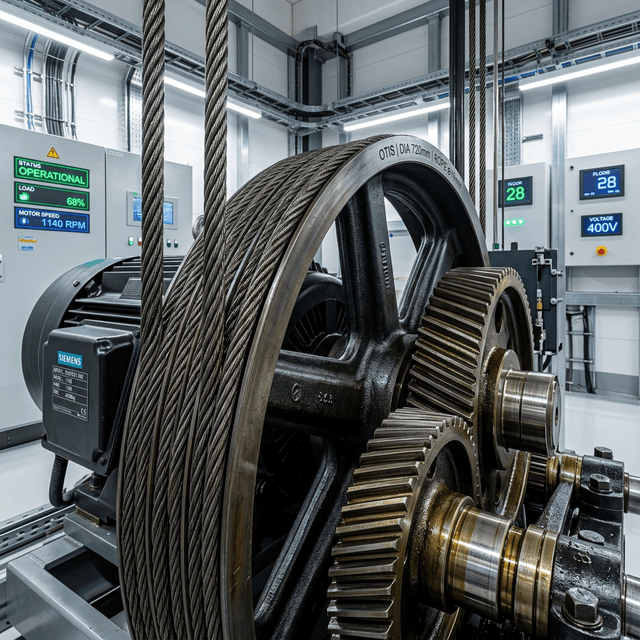
Geared Traction
These have a gearbox attached to the powered electric motor. These elevators typically operate at speeds from 125-500 feet per minute and carry heavy loads. They are known for their durability and consistent performance in mid-rise buildings.

Non-Geared Traction
The sheave in these elevators is directly attached to the motor, with no reduction box or gears. Gearless traction elevators are capable of speeds up to 2,000 feet per minute and they have a maximum travel distance of around 2,000 feet. They offer superior efficiency and ride comfort.

Non-Machine Room Elevators (MRL)
A machine room-less elevator or a MRL is device that typically houses the drive mechanism at the top of the hoist-way eliminating the need for a traditional machine room. Machine-room-less elevators have a maximum travel distance of 250 feet and can travel at speeds up to 500 feet per minute.

Precision Motors
Advanced Torque Motor technology ensuring maximum efficiency and minimal vibration during vertical transit.
Integrated Turbo Cooling
Dual-Disc Safety Brake

Contact Us
Connect with us for top-tier vertical mobility solutions across India.
Address
304, 3rd Floor, RG Complex-II, Prashant Vihar, New Delhi